RFID Tag Types Explained: 7 Categories, Frequencies & Use Cases
RFID is the contactless layer behind hotel keys, transit tickets, retail item tagging and warehouse inventory. This article covers seven of the most common tag formats — what they are, where they fit, and which chips RFIDAK ships in each.

Quick Answer
RFID tags are selected by power source, frequency and form factor. Passive, active and battery-assisted designs serve different read points; LF, HF/NFC and UHF need compatible readers. Compare the mounting surface, required distance, encoding and operating conditions before requesting a configuration-specific quote.
What is RFID Technology?
RFID (Radio Frequency Identification) uses electromagnetic fields to identify tagged objects without line-of-sight scanning — no aiming, no squinting, no “hold the barcode flatter.” A working system needs three pieces: a tag (chip + antenna fixed to the object), a reader (or interrogator) that emits the field, and a reader-side antenna that picks up the response.
The tag chip stores 64 bits to 8 KB of data depending on chip family. When the tag enters the reader's RF field, the reader's radio waves power the chip, which then transmits its stored data — typically a unique ID, a serialised EPC, or an NDEF record — back to the reader. The whole exchange takes milliseconds: the tag wakes up, states its name, and goes back to costing you nothing.
How Does RFID Work?
RFID technology operates through radio waves, and the choreography never changes. The reader emits radio frequency signals through its antenna. When an RFID tag enters the reader's electromagnetic field, it absorbs the energy and uses it to power its internal circuit — borrowed electricity, returned as information. The tag then modulates the radio waves and sends data back to the reader, which processes and forwards this information to a connected system.

How the three components work together
The reader broadcasts RF energy → the antenna captures and focuses the signal → the tag uses this energy to power its chip and transmit stored data back. This entire handshake happens in milliseconds, enabling hundreds of tags to be read per second.
7 Types of Regular RFID Tags
1. Passive RFID Tags
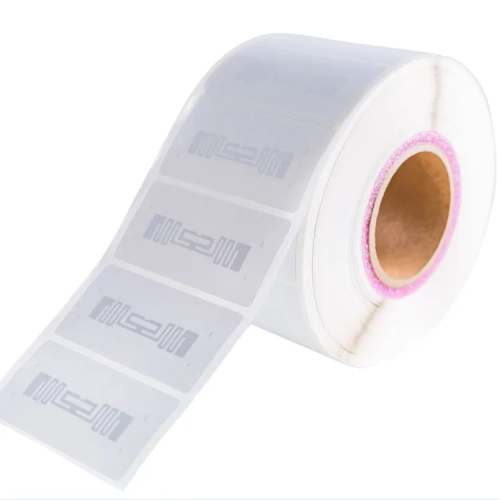
Passive RFID tags have no battery and draw operating power from a compatible reader. They are used for supply-chain, retail and access workflows; service life depends on the finished tag, mounting surface and exposure. RFIDAK offers UHF stickers, NFC stickers and RFID smart cards for evaluation with the installed system.
2. Active RFID Tags
Active RFID tags use an internal power source and can support longer-range location workflows, depending on the radio, site and infrastructure. Battery replacement and enclosure durability belong in the operating-cost calculation.
3. Semi-Passive RFID Tags
Semi-passive tags (also called battery-assisted passive or BAP tags) are the sensible hybrid: an internal battery powers the microchip, but they still rely on the reader's signal for communication — enough power to keep notes, not enough to shout. They offer better read ranges than purely passive tags and are often used in temperature monitoring, cold chain logistics, and toll collection systems.
| Tag Type | Power Source | Read Range | Battery Life | Cost |
|---|---|---|---|---|
| Passive | Reader energy | Up to 12 m | Unlimited | Quote by chip, form and volume |
| Active | Internal battery | Up to 100+ m | 3 – 5 years | Quote by device and infrastructure |
| Semi-Passive | Battery + reader | Up to 30 m | 2 – 7 years | Quote by sensor and battery design |
4. Low Frequency (LF) RFID Tags
Operating at 125-134 kHz, LF tags have a short read range (up to 10 cm) but excellent penetration through water and metal. They are commonly used in animal identification, access control keyfobs, and vehicle immobilizer systems.
5. High Frequency (HF) RFID Tags
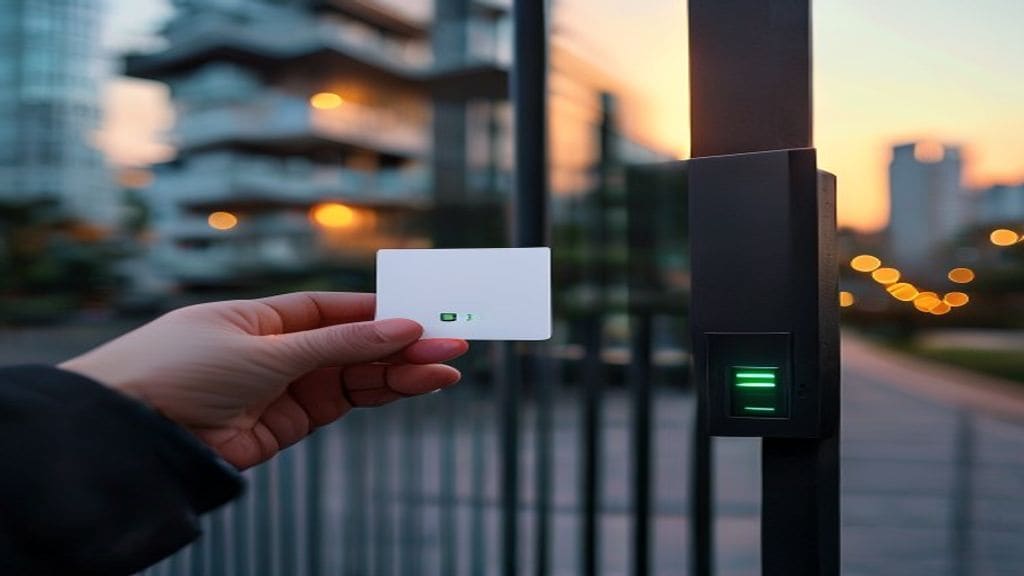
HF tags operate at 13.56 MHz and offer read ranges of up to 1 meter. The most popular HF standard is NFC (Near Field Communication). These tags are widely used in library management, contactless payments, smart cards, and public transportation ticketing. Learn more in our NFC technology guide.
6. Ultra-High Frequency (UHF) RFID Tags
UHF tags operate at 860-960 MHz and provide the longest read ranges (up to 12 meters for passive tags). They are the standard for supply chain and logistics tracking, retail inventory management, and industrial asset tracking. RFIDAK offers UHF stickers and UHF library labels for these applications.
7. Microwave RFID Tags
Operating at 2.45 GHz or higher, microwave RFID tags offer very fast data transfer rates and are used in specialized applications such as electronic toll collection, vehicle identification, and industrial automation systems.
| Frequency Band | Range | Read Distance | Typical Use Cases |
|---|---|---|---|
| LF (125 – 134 kHz) | Up to 10 cm | Short | Animal ID, access control, immobilizers |
| HF (13.56 MHz) | Up to 1 m | Medium | Smart cards, NFC, library, transit |
| UHF (860 – 960 MHz) | Up to 12 m | Long | Supply chain, retail, logistics |
| Microwave (2.45+ GHz) | Up to 10 m | Long | Toll collection, vehicle ID, automation |

Active vs Passive RFID: A 4-Question Decision Tree
Most procurement teams start with the wrong question — "active or passive?" — when the right starting point is the use environment — like choosing shoes by price before checking the weather. Walk through these four questions in order to land on the right tag class without over-spending on batteries or under-spending on range.
- Must the tag be located beyond a practical passive read point? — Evaluate an active or battery-assisted system, then test coverage and battery maintenance on site. Otherwise continue.
- Will the tag pass close to a reader (under 1 m) for contactless payment, identity, or transit? — Yes → HF/NFC 13.56 MHz (ISO/IEC 14443 / 15693). No → continue.
- Are you tagging items at scale (thousands+) for warehouse, apparel, or supply-chain inventory? — Yes → Passive UHF 860–960 MHz (ISO/IEC 18000-63, GS1 EPC). No → continue.
- Will the tag operate near metal, in water, or on livestock? — Yes → LF 125 kHz or on-metal UHF construction. No → default to passive UHF.
The frequency band you choose locks in the standards you must comply with — UHF deployments in the US (902–928 MHz, FCC Part 15) and EU (865–868 MHz, ETSI EN 302 208) use different power and channelization rules, so cross-region projects often need dual-band tags or region-specific SKUs. Read more in our RFID frequency guide.
7 RFID Tag Form Factors at a Glance
The same chip can ship in radically different physical packages — one actor, seven costumes. Form factor decides survivability (laundry, autoclave, outdoor), attachment method (sticker, lanyard, screw mount), and unit cost. RFIDAK ships every form factor below in stock or made-to-order.
| Form Factor | Best For | Typical Bands | Bulk Cost |
|---|---|---|---|
| Card | Access control, payment, transit, hotel keys | HF, LF | Quote by specification |
| Sticker / Inlay | Apparel, retail SKUs, high-volume tracking | UHF, HF | Quote by specification |
| Hard tag (on-metal) | IT assets, returnable bins, machinery | UHF | Quote by specification |
| Keyfob | Door access, gym, parking | LF, HF | Quote by specification |
| Wristband | Events, hotels, theme parks, hospitals | HF, UHF | Quote by specification |
| Laundry tag | Hotel linen and uniforms; confirm the model and wash process | UHF | Quote by specification |
| Animal ear tag / capsule | Livestock ID, pet microchips | LF | Quote by specification |

Real-World Use Cases by Tag Type
Tag-type choice in production almost always traces back to a published mandate, regulation, or pilot result — someone else already paid the tuition, so read their homework. Five examples that illustrate how the type / band / form-factor decision plays out at scale:
- Walmart-bound tagged items — passive UHF item-level inlays. Walmart's public packaging guide points to GS1 serialized encoding and category-specific Auburn ARC approved inlays. Check the exact item and packaging type before selecting a tag. See our Walmart RFID requirements guide.
- Disney MagicBand+ (theme parks) — HF/NFC + active 2.4 GHz hybrid wristband. NFC unlocks rooms and pays for purchases; the active radio links to attractions, ride photos, and lighting effects. Form factor: silicone wristband.
- Item-level retail pilot — passive UHF inlays on a defined product category. Test the approved inlay on representative packaging, then compare blind-count accuracy, missed reads and checkout or receiving time against the existing process before expanding the category.
- IATA Resolution 753 baggage tracking — passive UHF luggage tags. Carriers must track every bag at four points; Delta's 2016 rollout cut mishandled bags by 25%. Deeper dive: baggage tracking guide.
- EU livestock identification (Regulation 21/2004) — LF 134.2 kHz ear tags / boluses. Mandatory for sheep / goats EU-wide; LF survives mud, water, and dense biological mass where UHF cannot.
Choosing the Right RFID Tag
When selecting an RFID tag for your application, consider these factors: read range requirements, operating environment (temperature, moisture, metal presence), data storage needs, tag size constraints, and budget. The tag does not care about your feelings; it cares about the mounting surface.
Quick selection checklist
- Define your read range requirement — short (<10 cm), medium (<1 m), or long (>1 m)
- Identify environmental challenges — metal surfaces, moisture, extreme temperatures
- Decide on form factor — card, label, keyfob, wristband, or hard tag
- Check chip compatibility with your existing readers or system
- Evaluate volume and budget — unit cost drops significantly at scale
Key Takeaways
- Passive UHF tags support bulk inventory reads when the approved inlay, mounting material and reader setup pass a site test. Request pricing for the exact chip, construction, encoding and quantity.
- HF/NFC tags (13.56 MHz) own the smart-card, contactless-payment, and library-checkout space — read range under 1 m, ISO/IEC 14443 / 15693 standards.
- LF tags (125–134 kHz) remain the right call for animal/livestock ID, metal-rich environments, and legacy access control where 10 cm range is acceptable.
- Active tags need a battery and matching infrastructure; compare coverage and replacement cost for location or high-value asset monitoring.
- Selection sequence: match the environment first (metal, moisture, temperature), then choose the frequency band, then pick the form factor (card, label, keyfob, hard tag, wristband).
⚠️ Common pitfall
A standard UHF inlay may detune when placed directly on metal. Specify the mounting surface and compare a suitable on-metal construction on the actual asset with the intended reader.
RFID Tag Types FAQ
How long do passive RFID tags last?
Passive tags have no battery, but lifetime is determined by the finished construction, adhesive, read/write use and operating environment. Ask for the selected chip and tag specifications, then test representative samples under the intended handling conditions.
Can RFID tags be reused or re-encoded?
Yes — most UHF and HF tags allow the EPC / NDEF area to be re-written thousands of times. Locked or permalocked tags (e.g., bank cards, transit tickets) are intentionally write-once for security; reusable hard tags on returnable bins are designed for thousands of read/write cycles.
Do RFID tags work through metal?
Bare metal can detune a standard UHF inlay. An on-metal tag is engineered for that mounting condition; measure its range on the actual asset with your reader before ordering. LF designs still require a compatible reader and application protocol.
What is the cheapest type of RFID tag?
A simple passive inlay may be less expensive than a rugged hard tag, but current cost depends on chip availability, construction, encoding, inspection and quantity. Compare delivered quotes for the same specification; see the RFID pricing guide.
Are RFID and NFC the same thing?
NFC is a subset of HF (13.56 MHz) RFID standardised under ISO/IEC 14443 and 18092. Every NFC tag is an RFID tag, but not every RFID tag is NFC — UHF, LF, and active 2.4 GHz tags are RFID but cannot be read by a phone. Deeper dive: NFC technology guide.
Sources
- ISO/IEC 18000-63:2015 — UHF RFID air interface (Class 1 Gen 2). iso.org/standard/63675.html
- ISO/IEC 14443 — Identification cards: contactless proximity (HF). iso.org/standard/73598.html
- ISO/IEC 15693 — Vicinity contactless cards (longer-range HF). iso.org/standard/73602.html
- GS1 EPC Tag Data Standard 2.1 (2023). ref.gs1.org/standards/tds/
- FCC Part 15 §15.247 — UHF unlicensed band rules (US 902–928 MHz). ecfr.gov
- ETSI EN 302 208 — UHF RFID radio spectrum (EU 865–868 MHz). etsi.org
- IDTechEx — "RFID Forecasts, Players and Opportunities 2024-2034". idtechex.com
Not sure which tag fits your project? RFIDAK supplies the full range of RFID tags across LF, HF, and UHF bands plus active variants. Browse our full RFID product catalog or contact us for professional recommendations tailored to your specific application.
Need help turning this guidance into a product shortlist?
Use this next step when the article has narrowed the direction and you now need help choosing chips, formats, samples or the closest product family.
Comparison Pages
Compare the closest alternatives before you request samples
Open one of these if the article clarified the topic but the team still needs a cleaner format, chip or frequency decision.
Quick FAQ
Questions buyers often ask after reading this guide
What are the 7 main types of RFID tags?
The seven main types of RFID tags split along two axes: power source (passive, active or semi-passive) and frequency (LF 125-134 kHz, HF 13.56 MHz, UHF 860-960 MHz or microwave 2.45 GHz+). Passive UHF inlays under ISO/IEC 18000-63 dominate retail and logistics, passive HF under ISO/IEC 14443A handles smart cards and NFC, passive LF under ISO 11784/11785 covers livestock and immobilizers, while active and semi-passive variants serve real-time location and cold-chain sensor use cases.
What is the difference between active and passive RFID tags?
Active tags use a battery to transmit or assist communication; passive tags draw energy from the reader. Choose by required read point, update interval, environment, reader infrastructure, battery service and total cost. Test range on the real item rather than assuming one distance or price for every design.
Which RFID tag type is best for retail inventory?
For retail item-level inventory, start with a passive UHF EPC Gen2 inlay that meets the destination retailer's category and packaging requirements. Compare candidates by the required EPC encoding, approved inlay specification, tag placement and read performance on the actual product. HF/NFC serves separate short-range phone-tap workflows; choose it when that interaction is part of the requirement. Measure inventory accuracy and counting time in a pilot instead of assuming another retailer's result will transfer to your stores.
How much do RFID tags cost in 2026?
Unit price depends on the exact chip and inlay, finished construction, approved quantity per design, printing, encoding, packaging and QC requirements. Request a dated itemized quote showing sample and setup charges, unit tiers, freight and lead time; a generic chip or tag price does not establish the cost of the approved product.
Can a passive UHF RFID tag work on metal surfaces?
Yes, if the finished tag is designed and tested for the actual metal surface and read geometry. Standard free-air inlays may detune when placed directly on metal. Compare purpose-built on-metal label or hard-tag samples using the installed reader, antenna and mounting method. Ask for the exact model’s temperature and process ratings; a ceramic or PCB construction does not by itself establish sterilization suitability.
What ISO standard governs UHF RFID tags?
UHF RFID tags between 860-960 MHz follow ISO/IEC 18000-63, also known as EPC Gen2v2, maintained by GS1 EPCglobal. The same standard defines the air-interface protocol, anti-collision behavior and security commands. Reader fleets that support Gen2v2 will also read older Gen2 tags but not vice versa for newer security features. For HF use ISO/IEC 14443A (NFC, MIFARE) or 15693 (vicinity cards); for LF livestock use ISO 11784/11785; for microwave tolling use ISO/IEC 18000-4.
How long does a passive RFID tag last compared to active?
A passive RFID tag has no battery, so functional life is limited only by the inlay carrier: typically 10+ years for paper labels, 20+ years for PVC cards and 10-15 years for industrial PPS or ceramic tags. Active RFID tags depend on battery life, generally 3-5 years at standard beacon rates, after which the battery must be replaced or the tag retired. For long-lifecycle assets like steel containers or returnable transit packaging, passive UHF on metal usually outlives active tags by a factor of three or more.
What is the minimum order quantity for custom RFID tags?
RFIDAK's published standard tags-and-labels MOQ baseline is 1,000 pieces. Confirm the exact chip, antenna, construction, print, encoding and quantity per design in a written quote. Free stock samples (up to 5 pieces) — buyer covers DHL/FedEx freight ($25–60), refunded 1:1 against the first production order over $500. Larger evaluation lots, custom samples, production timing and delivery are agreed separately for the selected configuration.
Author
Wei Chen
RFID Applications Engineer at RFIDAK
Wei Chen is an RFID applications engineer at RFIDAK with 10+ years in RFID card and tag manufacturing in Shenzhen, focused on chip selection, laundry RFID durability testing and access-control compatibility.